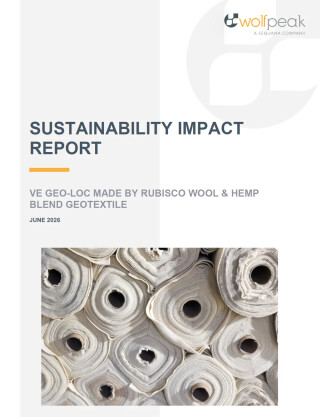
New Sustainability Impact Report on VE Geo-Loc, Hemp Geotextile
Independent assessment finds sustainability advantages for our hemp and wool geotextile
Temporary erosion control carries costs that never appear on the purchase order. Synthetic geotextiles have to be retrieved, transported and sent to landfill at the end of their service life, or left in the ground as a persistent plastic. A natural fibre product changes that equation, and a sustainability impact report by WolfPeak Group set out to establish by how much. Prepared for our Australian distributor Vital Chemical, it assesses VE Geo-Loc against four synthetic geotextiles and against imported jute and coir matting, on embodied carbon, whole-of-life cost and end-of-life behaviour.
Embodied carbon
Our Environmental Product Declaration, independently verified to ISO 14025 and EN 15804, reports a cradle-to-gate global warming potential of minus 1.40 kg CO2e per kilogram across modules A1 to A3, against published values of 1.83 to 4.33 for the four synthetic geotextiles assessed, which WolfPeak notes should be read as indicative given the differences in assumptions and system boundaries between manufacturers' declarations.
No equivalent product-specific declarations were identified for jute or coir, so no like-for-like carbon comparison against those materials was possible. For specifiers working to documented performance rather than material category, that absence is a finding in itself.
Whole-of-life cost
The report models a hypothetical scenario rather than a completed project, a 1,000 square metre batter and drainage corridor over two years, which it refers to as Site X. Within that scenario, total cost of ownership is 9.05 Australian dollars per square metre for VE Geo-Loc, against 12.91 for a recycled and virgin PET product and 11.34 for polypropylene, on rates WolfPeak draws from manufacturer pricing, published landfill levies and professional judgement and describes as illustrative rather than quotations.
Almost all of the difference is disposal and retrieval, modelled at zero for our product against 2.30 per square metre for both synthetics.
Microplastics and PFAS
Research cited in the report estimated approximately 1.69 million PET microplastic particles discharged to receiving waters per rainfall event through geofabric shedding on a major infrastructure project. Further research identifies polypropylene and polyester geotextiles as a possible source of ultrashort-chain PFAS, a pathway the report says requires further investigation.
VE Geo-Loc is made from natural fibres and contains no synthetic plastic polymers.
End of life
Soil burial testing cited in the report found greater than 95% mass loss for most untreated and conventionally processed wool fabrics. Our declaration states that the 500 gsm hemp and wool geotextile is typically fully biodegradable over 1.5 to 2 years, depending on microclimate, across a reference service life of two years.
As the fibres break down they return organic matter and nutrients to the soil, which is why the report frames the product as a shift from temporary protection and disposal to temporary protection and soil improvement.
Geotextile product range
Our geotextile range is supplied as a hemp and wool blend or as 100% wool, in rolls laid over prepared ground and pinned or staked using standard construction practice. The blend comes as 300 gsm rolls measuring 2 m by 30 m, the wool product as 300 gsm and 500 gsm rolls at the same dimensions, and both as 300 gsm tiles measuring 400 mm by 400 mm. The material contains no plastics, glues or formaldehydes.
Working with Vital Chemical
Vital Chemical is our exclusive Australian distributor and an Australian-owned and operated business, holding the supply, distribution and customer support relationship with the specifiers and contractors using the product. The report notes that the closeness of that relationship gives direct engagement with the manufacturing facility and visibility over sourcing and production, and that an Australasian supply chain reduces exposure to extended freight routes and shipping disruption relative to European or Asian imports.
Download the report
The full sustainability impact report is available through our partner, Vital Chemical.